Eight Reasons Tianeptine Shouldn't Be Placed in Schedule I
Millions of people worldwide take tianeptine sodium as a prescribed antidepressant at 12.5 mg 3x a day. At that dose, across 35 years and multiple controlled trials, there is no dependence or withdrawal, and a European regulator measured misuse at roughly one per thousand treated patients.
The harm in the US case reports comes from a different thing entirely. People taking 50 to 1,000 times the recommended dose develop significant dependence, withdrawal, and addiction. People combining those high doses with other sedatives have overdosed, with respiratory depression and death. Those cases are real and no serious comment should dispute them. But they describe a use pattern, in unregulated products, at doses no prescriber has ever written.
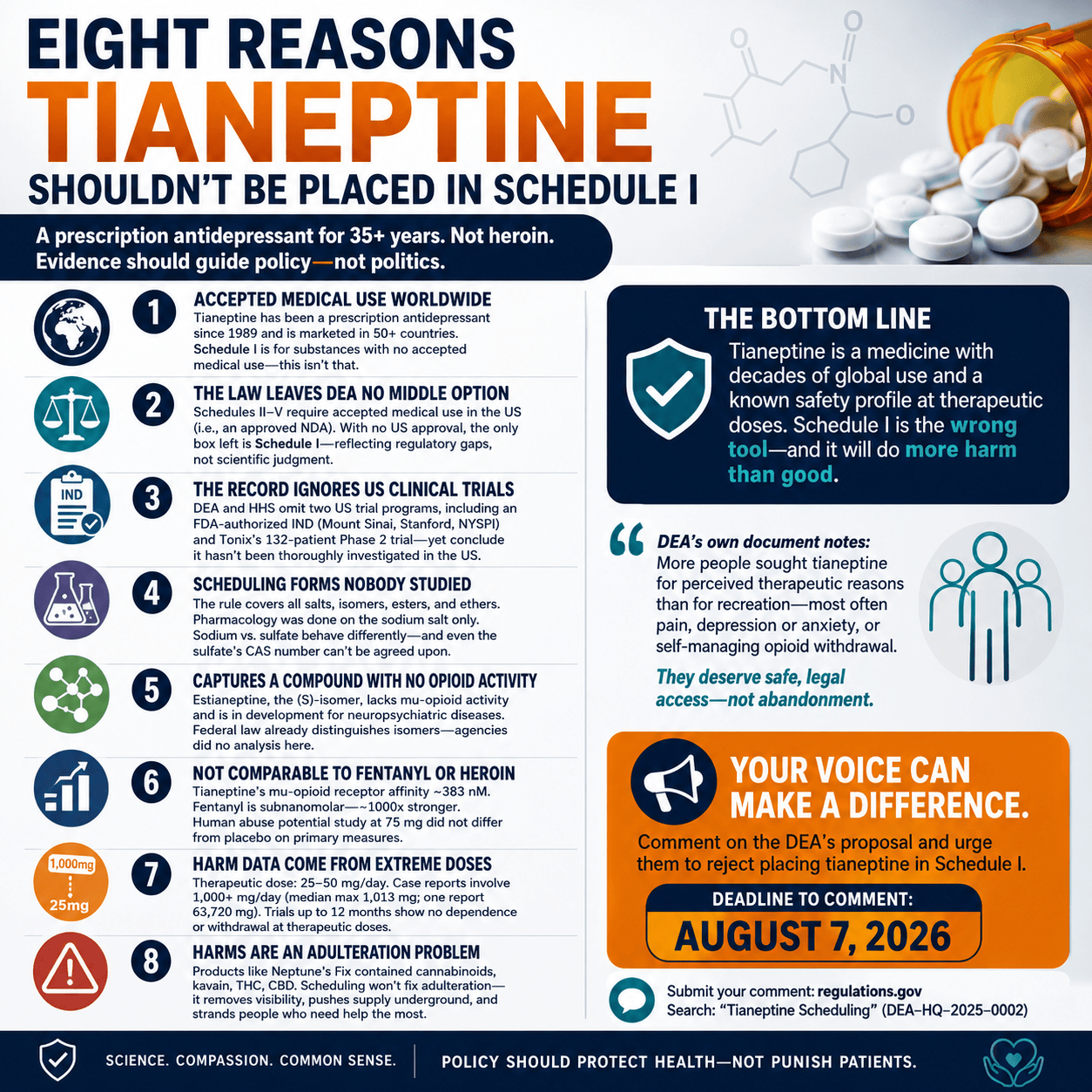
Why Tianeptine Doesn’t Meet The Schedule 1 Requirements as an Antidepressant Prescribed Worldwide
1. Schedule I means no accepted medical use anywhere in the world's most restrictive category. Tianeptine has been a prescription antidepressant since 1989. DEA's own document says it is marketed as a prescription antidepressant in more than 50 countries, under names like Stablon, Coaxil, and Tatinol. Schedule I is the category for substances with no accepted medical use and no accepted safety under medical supervision. That is heroin's category. Whatever tianeptine's risks are, "nothing medically useful is known about this drug" is not an accurate description of a medicine millions of patients have been prescribed for 35 years.
2. The law leaves DEA no middle option, and that is part of the problem. Schedules II through V all require a finding of currently accepted medical use in the United States, which DEA reads to require an approved US new drug application. Tianeptine has none, so the only box left is Schedule I. That means the placement reflects the absence of a US regulatory filing, not a scientific judgment that tianeptine is equivalent to heroin. It is also circular: Schedule I makes the clinical research needed for a US approval slower and costlier, so the classification based on the lack of US approval becomes an obstacle to ever obtaining one.
3. The record ignores two US clinical trial programs, including one FDA authorized. Neither the DEA eight-factor analysis nor the HHS Basis for Recommendation mentions the Mount Sinai, Stanford, and NYSPI trial in treatment-resistant depression, whose public registry entry states the investigator applied for and received an FDA IND to import and use tianeptine. Neither mentions Tonix's 132-patient placebo-controlled Phase 2 across roughly 27 to 30 US sites. Both documents nonetheless conclude tianeptine has not been thoroughly investigated as a new drug in the United States. FDA is part of HHS. The agency that granted the IND wrote the evaluation that omits it.
4. They are scheduling chemical forms nobody studied. The rule covers tianeptine plus all salts, isomers, esters, and ethers. But the receptor pharmacology DEA relies on was generated on a single form, the sodium salt, in three studies commissioned under a DEA-VA agreement in 2019. There is no separate pharmacology or human pharmacokinetic data for the sulfate, the hemioxalate, or any isomer anywhere in either document. The two marketed salts behave differently: sodium clears in about three hours and is dosed three times daily, while the sulfate is slower. That difference matters for dependence risk and was never analyzed. The documents cannot even agree on the sulfate's chemical identifier, listing three different CAS numbers across three parts of the same rulemaking.
5. The rule would capture a compound with no opioid activity at all. A US company, Tonix, is developing estianeptine, the (S)-isomer of tianeptine, for depression, Alzheimer's, and Parkinson's. Its stated advantage is that it lacks mu-opioid receptor activity. Mu-opioid activity is the entire basis for scheduling tianeptine. Yet the blanket isomer language sweeps in a molecule that does not have the property being regulated. Federal law already knows how to handle this: levomethorphan is Schedule II while its mirror image dextromethorphan is sold over the counter in cough syrup. The agencies did no isomer analysis whatsoever. The word appears in DEA's document only inside boilerplate.
6. Tianeptine is not comparable to fentanyl or heroin, and DEA's own data say so. Tianeptine binds the human mu-opioid receptor with an affinity around 383 nM. Fentanyl's is subnanomolar, roughly a thousandfold difference. DEA's own analysis describes tianeptine as producing a morphine-like response with decreased potency. HHS describes a human abuse potential study at 75 mg that did not separate from placebo on the primary measures. None of this makes tianeptine harmless. It does mean the fentanyl comparisons circulating in coverage of this rule are not what the underlying data show, and the Schedule I conclusion never carries DEA's own potency finding forward.
7. The harm data come from doses twenty to a thousand times the therapeutic dose. The approved dose abroad is 25 to 50 mg per day. In the case series the agencies rely on, the median maximum single-day dose was 1,013 mg, with one report of 63,720 mg. Meanwhile France's Transparency Committee found misuse in roughly one per thousand patients treated at antidepressant doses, and controlled trials of six weeks, three months, and twelve months found no dependence or withdrawal at therapeutic dosing. Treating a 25 mg prescription and a 1,000 mg gas-station product as the same thing is the core analytical failure of this rule.
8. The US harms are largely an adulteration problem, and scheduling makes it worse. The Neptune's Fix cluster that drove much of the alarm involved products that, on testing, contained synthetic cannabinoids, kavain, THC, and CBD alongside tianeptine. People were poisoned by unlabeled contents in unregulated products. Tianeptine is already an unapproved drug and an unlawful dietary ingredient, and FDA already has seizure and recall authority it has used. Schedule I creates no purity, labeling, or dose control. It removes what visibility exists and pushes supply further underground, which is how the adulteration got there. And it strands the people already using it. DEA's own document notes HHS found more people sought tianeptine for perceived therapeutic reasons than for recreation, most often pain, depression or anxiety, or self-managing opioid withdrawal. Those people lose access overnight, with no taper and no clinician who can legally help, from a substance the same document says produces opioid-like withdrawal.
FAQs
Is tianeptine being banned in the United States?
Not yet. On July 8, 2026, the DEA published a proposed rule to place tianeptine in Schedule I of the Controlled Substances Act, under Docket No. DEA-1596. A proposed rule is not law. The public has until August 7, 2026 to submit comments at regulations.gov, and the agency has to consider them before finalizing anything. Tianeptine is currently unscheduled at the federal level, though about a dozen states have already banned or restricted it.
What does Schedule I actually mean?
It is the most restrictive category in US drug law. To place something there, the government has to find three things: high potential for abuse, no currently accepted medical use in the United States, and no accepted safety for use under medical supervision. Heroin is Schedule I. So are LSD and MDMA. Notably, cocaine and fentanyl are Schedule II, because they have recognized medical uses.
Schedule I is not simply a stronger version of Schedule II. It is a different kind of finding. It says a substance is medically useless, not just dangerous.
Is tianeptine a real medicine?
Yes, in most of the world. It has been prescribed as an antidepressant since 1989 and is marketed in more than 30 countries under names including Stablon, Coaxil, Tatinol, and Tianeurax. The DEA's own document says so. It has never been approved in the United States, which is the technical reason Schedule I is the only category available under US law, but "not approved here" and "no medical use anywhere" are very different statements.
Is tianeptine like fentanyl?
No, and the comparison has done a lot of damage. Tianeptine binds the human mu-opioid receptor with an affinity of roughly 383 nM. Fentanyl's is subnanomolar, roughly a thousand times stronger. The DEA's own analysis describes tianeptine as producing a morphine-like response with decreased potency, and HHS describes a human abuse potential study at 75 mg that did not separate from placebo on the main measures.
That does not make it harmless. It does mean the headlines calling it a fentanyl analogue or comparing the two are not describing what the data show.
If it's not dangerous, why have people been hospitalized and died?
Because the cases involve a completely different exposure than the medicine. The prescribed dose abroad is 25 to 50 mg a day. In the case series the agencies rely on, the median maximum single-day dose was 1,013 mg, with one report of 63,720 mg. At those doses, people develop significant dependence, withdrawal, and addiction. People who combined high-dose tianeptine with other sedatives have overdosed, with respiratory depression and death.
There is also a product problem. The Neptune's Fix cluster that drove much of the alarm involved bottles that, on testing, contained undisclosed synthetic cannabinoids, kavain, THC, and CBD. Some of those poisonings were not caused by tianeptine at all.
What is "gas station heroin"?
A media nickname for unregulated tianeptine products sold in convenience stores and smoke shops as supplements or "brain enhancers." It is not a scientific term and it obscures more than it explains. These products are already illegal to sell. Tianeptine is an unapproved drug and an unlawful dietary ingredient, and FDA already has authority to seize them.
Won't Schedule I fix the gas station products?
That is the assumption, and it is worth questioning. Scheduling does not create purity standards, labeling, or dose control. The products that hurt people were dangerous because nobody knew what was in the bottle. Making possession a federal crime does not change what is in the bottle. It does remove what visibility exists, push supply further underground, and make people less likely to tell an emergency physician what they took.
Who gets hurt if this rule is finalized?
People currently taking it, first. Schedule I placement does not come with a taper plan. On the effective date, people who have been using tianeptine daily face abrupt discontinuation of a mu-opioid receptor agonist, with no clinician who can legally prescribe a taper and no approved product to switch to. The agencies' own documents describe the withdrawal as opioid-like.
DEA's document also notes that HHS found more people sought tianeptine for perceived therapeutic reasons than for recreation, most often pain, depression or anxiety, or self-managing opioid withdrawal.
What does this do to research?
It makes it dramatically harder. Schedule I adds security requirements, storage rules, quotas, inspections, and years of administrative delay. Two US clinical programs have already stopped, one at Mount Sinai, Stanford, and NYSPI under an FDA-authorized IND, and one industry Phase 2 across roughly 27 to 30 US sites. Neither appears anywhere in the DEA or HHS evaluations, both of which conclude that tianeptine has not been thoroughly investigated as a new drug in the United States.
There is a loop here. The classification rests partly on the absence of US clinical data, and then makes generating US clinical data much harder.
Does tianeptine help with chronic pain or fibromyalgia?
There is a real research line, and it is not in the agency record. A randomized, double-blind, placebo-controlled trial of tianeptine in fibromyalgia was completed in Barcelona in 2007, prospectively registered as ISRCTN16400909. Results were never published. A completed randomized trial compared tianeptine to pregabalin for post-mastectomy pain syndrome. Preclinical work from Mount Sinai in 2023 showed lasting relief of nerve-injury pain in animals without the tolerance or withdrawal that limits opioids.
None of that establishes that tianeptine treats fibromyalgia. It establishes that the question is open and testable. Neither the DEA document nor the HHS document contains the word fibromyalgia, or the phrase chronic pain, even once.
I'm taking tianeptine. What should I do?
Do not wait for the effective date to make a plan. Talk to a clinician who understands opioid pharmacology now, while there is still time to taper deliberately. Abrupt discontinuation is the outcome to avoid, and that gets much harder once the legal supply and the legal ability to help you both disappear.
How do I comment, and does it matter?
Comments go to regulations.gov under Docket No. DEA-1596, due August 7, 2026. They matter more than people assume, because the agency has to respond to substantive comments and an unaddressed comment can become a problem for the rule later.
A few things make a comment count. Say who you are and how this affects you specifically. Pick one or two concrete problems rather than restating everything. Be accurate, because overstating the case gives the agency an easy reason to dismiss every comment that sounds like yours. And ask for something DEA can actually do: supplement the record to address the FDA-authorized IND and the completed US trials, narrow the chemical scope to exclude isomers that lack opioid activity, preserve research and analytical access through existing exemption mechanisms, set a delayed effective date with clinical guidance, or enforce existing FDA authority against adulterated products.
