DEA's Rush to Schedule SR-17018: What the Data Shows
On July 1, 2026, DEA published a notice of intent to temporarily place four synthetic opioids into Schedule I: cychlorphine, spirochlorphine, SR-14968, and SR-17018. All four get grouped together as "orphines," treated as one hazard, and given thirty days before the order takes effect.
Here's the problem. Two of those compounds have a real, documented public health footprint. Two of them don't. DEA's own numbers say so.
I filed a formal objection with DEA's Drug and Chemical Evaluation Section on July 28, 2026. I asked DEA to look at each compound individually, the way the science actually supports, instead of scheduling by chemical family tree. READ HERE
Key Takeaways
DEA reports 265 total encounters across all four compounds, but 261 of them belong to just two: cychlorphine and spirochlorphine.
SR-14968 has never been confirmed in a human being. It has been found in seized drug material only.
SR-17018's own primate data shows a weaker respiratory depression signal than oliceridine, an opioid FDA has already approved.
The main documented real-world use of SR-17018 is people using it to taper off fentanyl, heroin, methadone, and other opioids.
The temporary scheduling order could be published as soon as July 31, 2026, and once it posts, SR-17018 becomes Schedule I immediately, with no separate notice period. As of this writing, no order has posted.
Grouping four chemically related compounds under one emergency order doesn't make them pharmacologically or epidemiologically equivalent, and DEA's own record proves it.
Quick Answer: DEA's own data shows SR-14968 and SR-17018 have a forensic footprint more than one hundred times smaller than cychlorphine and spirochlorphine, and neither compound has produced a confirmed fatality, which is why they need a compound-specific review, not a group scheduling order.
Introduction
When a federal agency schedules four compounds under one order because they share a chemical family, it's worth asking whether the family resemblance is doing more work than the evidence. That's exactly what's happening with DEA-1665.
I've spent two decades studying opioid receptor pharmacology, plant-derived medicines, and how federal drug policy actually lands on real patients. I've watched agencies move fast on emerging compounds before, and I've watched the record catch up to the policy years later, after real harm was already done to people who lost access to something that was helping them.
This isn't a hypothetical timeline. DEA's own notice states the order "will not be issued before July 31, 2026," and that the agency intends to issue it "as soon as possible" after that date. As of this writing, nothing has posted to the docket. That means SR-17018 could become a Schedule I substance at any point from here forward, with no additional notice and no separate comment window before it takes effect.
Here's what we'll cover: what DEA's own numbers say when you actually disaggregate them, what the pharmacology shows when you read past the single study DEA cites, what people are really doing with SR-17018 online, and what I'm formally asking DEA to do about it.
Most coverage of this notice will repeat DEA's framing of "four synthetic opioids." I'm going to show you why that framing doesn't survive contact with DEA's own data.
The Numbers DEA Already Has
DEA's notice reports 265 total NFLIS-Drug encounters across all four compounds. Disaggregate that, and it's not an even split.
Cychlorphine accounts for 225 of those encounters, across 19 states. Spirochlorphine accounts for 36, across 6 states. SR-14968 and SR-17018 account for 2 each, nationally, since 2025.
Two. Nationally. Since 2025.
Cychlorphine's encounter count is more than one hundred times that of either SR compound. DEA TOX has confirmed cychlorphine in 49 fatalities. For SR-14968, DEA's own notice does not report a single confirmed human toxicology case, anywhere, ever. It has been found in seized drug material. It has not been found in a person.
That's not a rounding error. That's the difference between a documented public health emergency and finding something in a bag once.
Takeaway: When you disaggregate DEA's own encounter data, two of the four compounds don't share anything close to the same forensic footprint as the other two.
The Pharmacology Doesn't Support Treating Them the Same
DEA cites one 2021 study to justify grouping SR-14968 and SR-17018 with fentanyl-like agonists. The more recent, more directly comparative literature says something different.
DEA's notice cites Kudla et al. 2021 to establish that SR-14968 and SR-17018 produce dose-dependent antinociception and physical dependence, the same paper it leans on to group them with conventional full mu-opioid receptor agonists. What the notice doesn't mention is what's been published since.
Zamarripa et al. 2024 compared fentanyl, oxycodone, SR-14968, and SR-17018 head to head in rats. Only fentanyl and oxycodone produced dose-dependent respiratory depression. Not the SR compounds. Stahl et al. 2021 and Grim et al. 2020 both found SR-17018's effects remain fully reversible by opioid antagonists, and that chronic SR-17018 doesn't produce the tolerance or receptor desensitization morphine does.
Then there's the primate data, and this is where it stops being a rodent-model argument and starts being directly relevant to human risk. Cornelissen et al. 2021 ran SR-14968 and SR-17018 head to head against oliceridine, an FDA-approved biased opioid agonist already used in hospitals, in rhesus monkeys. Oliceridine, the approved drug, dropped oxygen saturation below the clinical hypoxia threshold in two of three monkeys. SR-14968 never crossed that threshold in any monkey. SR-17018 crossed it in one monkey, and less severely than oliceridine did.
Read that again. In a head-to-head primate comparison, the compound FDA already approved showed a more pronounced respiratory depression signal than the two compounds DEA now wants to place in Schedule I on an emergency, no-comment basis.
A second primate study, Ko et al. 2023, measured SR-17018's abuse liability directly, using intravenous self-administration in monkeys, the gold-standard assay for this question. Heroin produced significantly higher reinforcing strength than SR-17018. SR-17018's abuse liability tracked buprenorphine, a Schedule III medication approved specifically because its abuse liability is low.
Takeaway: The pharmacological literature published after the single study DEA cites points toward a meaningfully different risk profile for SR-14968 and SR-17018, not equivalence with fentanyl.
What People Are Actually Using SR-17018 For
DEA's notice cites rising online discussion of SR-17018 as evidence of an emerging abuse pattern. I read the same alert DEA cites. It doesn't say what DEA implies it says.
DEA cites an NDEWS alert on SR-17018 discussion as part of its evidence. I reviewed that same alert while preparing separate comments to HHS. It documents Reddit users sharing tapering protocols and dose calculators for using SR-17018 to get off fentanyl, heroin, methadone, buprenorphine, and other opioids.
That is not drug-seeking behavior. That's harm reduction, happening in the wild, because people couldn't get it anywhere else. DEA's own notice even acknowledges that users report using SR-17018 to "reduce or reset opioid tolerance." It frames that only as an overdose risk on the next hit of something else. It doesn't mention that Grim et al. found SR-17018 substitution in morphine-tolerant mice both prevented withdrawal and restored morphine sensitivity, which is exactly the mechanism that would explain why people report it working that way for them.
A 2026 self-reported observational registry of 55 people with prior opioid use histories found that 69.1 percent had three or more prior detox attempts, 54.5 percent reported full opioid cessation during SR-17018 exposure, and 87.3 percent reported some form of improvement. That registry is uncontrolled and self-reported. It doesn't prove SR-17018 is safe or effective. It does prove the same online activity DEA cites as evidence of abuse is also, on its face, evidence of people trying to leave more dangerous opioids behind.
Takeaway: The behavior DEA is citing as a risk signal is largely people documenting their own attempts to get off harder opioids, not seeking SR-17018 for recreational use.
How the Four Compounds ComparE
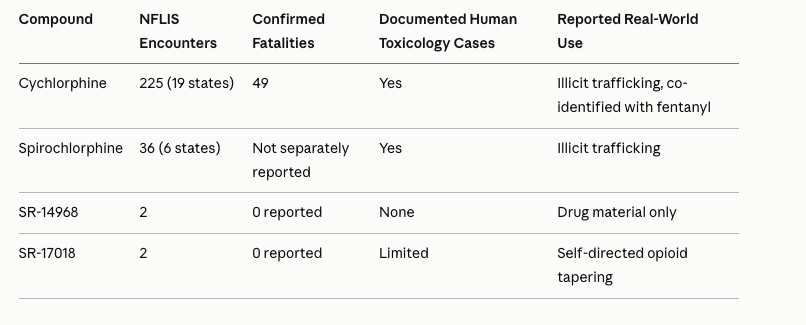
Two compounds on this table have a documented public health emergency. Two don't. Scheduling all four the same way treats a rounding-error footprint like a documented crisis.
What I'm Asking DEA To Do
I'm not asking DEA to leave cychlorphine or spirochlorphine off the schedule. The record supports emergency action there. What I'm asking for is narrower: sever SR-14968 and SR-17018 from this order, or at minimum extend the notice period as to those two compounds specifically, so a compound-specific record can actually be built before people lose access and before a research pathway into safer, tolerance-sparing opioid agonists gets locked behind Schedule I registration requirements.
This isn't the first time DEA has moved fast on an opioid-receptor compound and later had to walk it back. DEA proposed emergency scheduling of mitragynine and 7-OH in 2016, then withdrew that notice after public comment. HHS rescinded its own scheduling recommendation on those compounds the following year, citing a relative lack of evidence. The lesson isn't that these compounds are the same. It's that a thirty-day emergency timeline, with no notice-and-comment process and no judicial review, is a bad setting to finalize the record on a novel compound class for good.
Takeaway: DEA has a documented history of scheduling opioid-receptor compounds too fast and then reversing course. That history is exactly the argument for slowing down on SR-14968 and SR-17018 now, before the order issues rather than after.
Where This Stands Right Now
DEA has not yet issued the temporary scheduling order. When it does, SR-17018 becomes Schedule I the same day, with no further warning.
Under 21 U.S.C. 811(h), a temporary scheduling order takes effect the moment it's published in the Federal Register. There's no additional comment period once that happens, and temporary scheduling orders aren't subject to judicial review. July 31, 2026 was the earliest date DEA could publish. It hasn't yet, as of this writing, but it can happen at any time from here forward.
If you work with SR-17018 in any capacity, research, clinical evaluation, or advisory work tied to it, that status can change without further notice. Track the docket directly on the Federal Register.
Takeaway: The scheduling order can land at any moment now, and once it does, there's no grace period.
FAQs
What is SR-17018?
SR-17018 is a synthetic, G-protein-biased mu-opioid receptor agonist. Peer-reviewed studies, including primate research, show it produces less respiratory depression than an already FDA-approved comparator and has abuse liability comparable to buprenorphine rather than heroin.
Why is DEA trying to schedule SR-17018?
DEA grouped SR-17018 with three other "orphine" compounds in a July 1, 2026 notice of intent, citing rising online discussion and structural similarity to other synthetic opioids, rather than a compound-specific toxicology or fatality record.
Has SR-17018 caused any deaths?
DEA's own notice does not report a confirmed fatality tied to SR-17018. The compound accounts for only 2 NFLIS-Drug encounters nationally since 2025.
What are people actually using SR-17018 for?
The documented real-world use pattern, per DEA's own cited source, is people using SR-17018 to taper off fentanyl, heroin, methadone, buprenorphine, and other opioids, not recreational use.
When could SR-17018 actually become Schedule I?
DEA's notice states the temporary order will not be issued before July 31, 2026, and that the agency intends to publish it as soon as possible after that. As of this writing, the order has not posted. Once it does, the scheduling takes effect immediately.
What happened last time DEA fast-tracked scheduling on a similar compound?
DEA proposed emergency scheduling of mitragynine and 7-OH in 2016 and withdrew the notice after public comment. HHS later rescinded its own recommendation to schedule those compounds, citing insufficient evidence.
Can the public comment on this DEA notice?
DEA-1665 does not include a standard public comment period. This objection was filed as an unsolicited technical submission requesting the docket include it and that DEA extend the notice period for SR-14968 and SR-17018 specifically.
What You Should Do Now
If you work in medical affairs, regulatory strategy, or legal defense in the alternative medicine or opioid-receptor pharmacology space, this is the kind of policy shift that can move fast and change your compliance picture overnight. Emergency scheduling orders like DEA-1665 aren't subject to judicial review, which means the window to get the record right is before the order issues, not after.
If your company works with compounds anywhere near this chemical class, or if you need someone who can read a Federal Register notice and tell you what the underlying pharmacology actually supports, that's the work I do at Infused Partners. I help companies and legal teams navigate exactly this kind of regulatory moment, translating the science into a defensible position before the deadline closes.
The compounds DEA is scheduling today shape what treatments are available tomorrow. Getting the record right matters more than getting it fast.
